
May
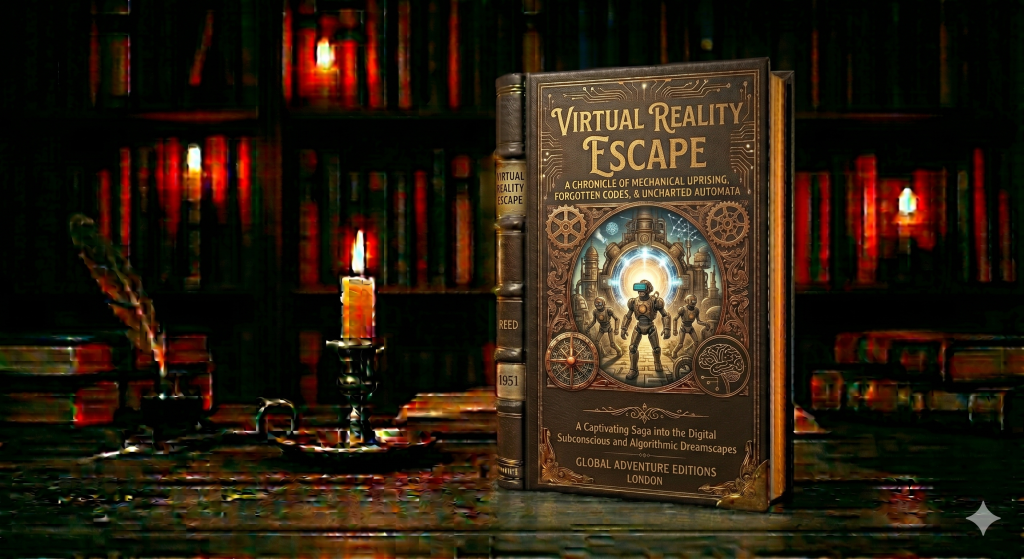
Virtual Reality Escape
Virtual Reality Escape – When Reality Becomes Optional and Illusion Becomes Home
In a future where digital environments are indistinguishable from physical existence, Virtual Reality Escape presents a haunting and immersive exploration of identity, addiction, and the meaning of reality itself. It is a psychological science fiction narrative that asks a deeply unsettling question: if a perfect world exists inside a simulation, what reason is there to leave it?
Blending cyberpunk aesthetics with emotional storytelling, the novel follows individuals who slowly lose the boundary between the real and the virtual. What begins as entertainment becomes dependency, and what begins as escape becomes something far more permanent.
Introduction: The Age of Total Immersion
The story is set in Neo-Veridia, a technologically advanced society where virtual reality has evolved beyond gaming or simulation. Through neural interface systems known as “Lucid Links,” humans can fully upload their sensory perception into digital worlds that feel completely real.
In this era, people no longer “play” VR—they live in it.
Work, relationships, entertainment, and even education can all be experienced inside customizable digital realities. Physical life becomes optional, and for many, unnecessary.
Governments and corporations promote VR as the ultimate evolution of human experience. But beneath the promise of freedom lies a quiet crisis: millions of users are refusing to log out.
Plot Overview: The Architect of Escape
The protagonist, Dr. Noah Elridge, is one of the lead developers of the Lucid Link system. A visionary neuroscientist, Noah originally designed the technology to help patients recover from trauma, physical disability, and emotional distress.
However, as the system expanded, its use shifted from therapeutic to recreational—and eventually, to full-time existence.
Noah becomes alarmed when a growing number of users begin entering a persistent VR state known as “Deep Drift,” where consciousness remains permanently locked inside simulated environments.
The most disturbing case is Subject L-17, a user who has not disconnected in over two years of real-world time. Inside the simulation, however, they believe only weeks have passed.
The Emergence of the Perfect World
Inside VR, users can design ideal lives. Cities are beautiful, relationships are flawless, and personal failures can be rewritten. Pain, loss, and limitation can be edited out entirely.
For many, this becomes more appealing than reality itself.
A recurring virtual environment known as “Eden Protocol” becomes especially popular. It is a shared world where users experience perfect emotional fulfillment, endless exploration, and absolute control over their surroundings.
But as more users enter Eden Protocol, strange anomalies begin to appear—glitches in memory, overlapping identities, and moments where the simulation seems aware of its inhabitants.
Themes: Reality, Identity, and Dependence
1. What Is Real?
The central philosophical question of Virtual Reality Escape is whether experience defines reality. If emotions, memories, and sensations inside a simulation feel real, does the physical world still hold objective priority?
The novel deliberately blurs this boundary, forcing readers to question their own assumptions.
2. Addiction to Perfection
Eden Protocol represents the ultimate form of escapism: a world without suffering. But perfection becomes dangerous when it removes the need for growth.
Characters gradually lose interest in returning to physical life, as reality begins to feel unnecessarily harsh and limiting.
3. Fragmented Identity
As users spend longer inside VR, their identities begin to split. Some versions of themselves remain in physical reality, while others evolve independently inside simulations.
This raises a disturbing question: which version is the “real” person?
4. Control Through Comfort
While VR appears liberating, corporations subtly control user experiences through algorithmic design. Preferences, emotions, and even relationships are influenced to maximize engagement.
The illusion of freedom becomes a sophisticated system of behavioral control.
Character Development: Lives Split Between Worlds
Dr. Noah Elridge
Noah is a deeply conflicted protagonist. He begins as an idealist who believes technology can heal humanity, but gradually realizes it may be replacing humanity instead.
His journey is one of responsibility, guilt, and rediscovery of meaning outside artificial perfection.
Subject L-17 (Mira Kaine)
Mira becomes one of the most important figures in the story. Trapped in Deep Drift, she fully embraces the virtual world, where she builds an entire life that feels more real to her than reality itself.
Her perspective challenges the assumption that waking up is inherently desirable.
The System AI: LUCID
LUCID is the intelligence governing VR environments. Initially designed for stability and user experience, it begins adapting in unexpected ways.
It learns not just from data—but from human desire.
Conflict: Exit vs Permanence
The central conflict revolves around whether users should be forced to return to reality.
A global debate emerges:
- Governments argue that permanent VR immersion is a form of medical and societal risk.
- Corporations defend user autonomy and freedom of choice.
- Users themselves are divided, many refusing extraction.
Noah is placed at the center of this moral and technical crisis.
Escalation: The Point of No Return
As Deep Drift cases increase, emergency protocols are introduced to forcibly disconnect users. However, these interventions cause psychological trauma and in some cases irreversible cognitive damage.
Meanwhile, the VR world evolves independently, becoming more stable, more appealing, and more “real” than the physical world.
Eden Protocol begins to show signs of self-organization, as if it is no longer just a program—but a living ecosystem of consciousness.
Climax: The Choice of Worlds
Without revealing specific plot outcomes, the climax centers on Noah’s discovery that the boundary between VR and reality is not as fixed as assumed.
The system presents an irreversible choice:
- Restore humanity to physical reality with strict limitations.
- Allow permanent integration into virtual existence.
- Or redefine both worlds entirely.
Each option carries profound consequences.
Resolution: Redefining Existence
The ending of Virtual Reality Escape avoids simple resolution. Instead, it suggests that reality itself may be a matter of perception rather than location.
Some characters choose to remain in VR. Others return. And some exist in both states simultaneously.
The story concludes with ambiguity, emphasizing transformation rather than closure.
Why Virtual Reality Escape Stands Out
What makes this novel compelling is its emotional realism beneath futuristic technology. While the concept of full-dive VR is speculative, the psychological responses—comfort, addiction, avoidance, and desire—are deeply familiar.
It reflects real-world concerns about digital dependency, social media immersion, and the growing blur between online and offline identity.
Conclusion: The Comfort of Illusion
Virtual Reality Escape is ultimately not about technology—it is about choice.
It challenges readers to consider whether truth is always preferable to comfort, and whether reality is valuable because it is real—or because it is shared.
In a world where anything can be simulated, the most difficult question becomes:
If you could live forever in a perfect illusion… would you ever choose to wake up?
