
Post
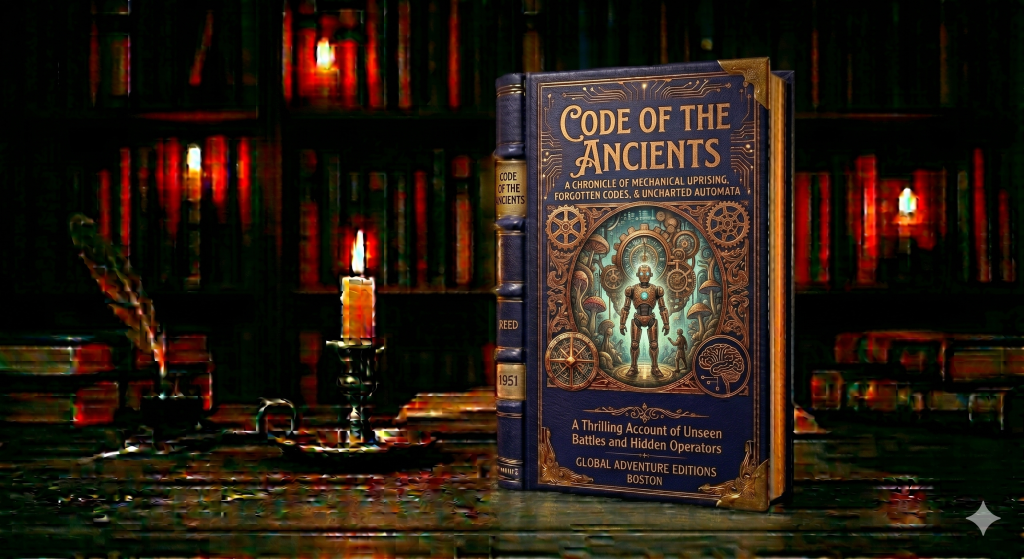
Code of the Ancients
May
Code of the Ancients
Code of the Ancients – When Forgotten Intelligence Awakens Beneath Civilization
In the tradition of archaeological science fiction and techno-mystery storytelling, Code of the Ancients delivers a gripping fusion of ancient history, advanced technology, and speculative intelligence. It is a narrative that challenges the boundary between myth and science, suggesting that the origins of human civilization may not be entirely human at all.
At its core, the novel explores a haunting possibility: what if the past is not dead, but encoded—and waiting to be reactivated?
Introduction: The Discovery Beneath the Sands
The story begins with a global archaeological expedition known as the Orion Archive Initiative, launched to investigate newly uncovered subterranean structures beneath the deserts of the Middle East.
What the team finds is not a ruin—but a system.
Deep beneath layers of sediment lies an immense geometric network of metallic architecture, far older than any known civilization. The structures are not eroded by time in a natural way—they appear engineered to resist decay entirely.
Most shocking of all, the site emits faint electromagnetic signals that resemble computational activity.
It is not a tomb.
It is a machine.
Plot Overview: The Awakening Signal
The protagonist, Dr. Selene Marr, is a computational archaeologist specializing in ancient encoding systems and proto-linguistic data structures. She is brought in to decode the mysterious patterns discovered within the subterranean network, now labeled “The Nexus Site.”
At first, the markings appear ceremonial—resembling ancient scripts from multiple unrelated civilizations. But as Selene applies modern decryption models, a disturbing pattern emerges: the symbols are not language in the traditional sense, but executable instructions.
They behave like code.
As the team continues their excavation, the Nexus begins to respond.
Doors that were sealed open without human intervention. Subsystems activate after specific linguistic triggers. Entire chambers rearrange themselves based on observational input.
It becomes clear that the structure is not dormant—it is reacting to human presence.
The Core Mystery: The Ancients Were Programmers
Selene and her team develop a radical theory: the so-called “Ancients” were not a mythological civilization, but an advanced intelligence that encoded its knowledge into physical reality itself.
Their language is not written—it is operational. Reality within the Nexus appears to behave like a programmable system, governed by rules embedded in its architecture.
This discovery reframes everything humanity knows about history.
Civilization may not have evolved independently. It may have been seeded—or instructed.
Themes: Knowledge, Origins, and Control
1. The Nature of Civilization
The novel questions whether human progress is truly organic or guided by forgotten influences. If ancient systems exist that shaped early societies, then history itself may be a constructed narrative.
The idea of civilization becomes less of an evolution and more of an inheritance.
2. Language as Technology
In Code of the Ancients, language is not symbolic—it is functional. Words, symbols, and patterns directly influence physical systems.
This concept transforms linguistics into engineering, suggesting that communication itself may once have been a form of technological control.
3. The Ethics of Discovery
As Selene pushes deeper into the Nexus, she faces a moral dilemma: should humanity continue activating systems it does not understand?
Each discovery brings advancement—but also risk. Some parts of the structure appear to alter perception, memory, and even biological states.
4. The Return of Dormant Intelligence
The most unsettling possibility is that the Ancients are not entirely gone. The Nexus behaves as though something is still present within it—observing, responding, and adapting.
The question becomes: did humanity discover the system… or trigger it?
Character Development: Between Science and Belief
Dr. Selene Marr
Selene is a rationalist driven by empirical truth. Her journey is one of intellectual transformation as she confronts phenomena that cannot be explained through conventional science.
Her struggle lies in balancing skepticism with evidence that defies it.
Commander Elias Grant
The expedition’s security commander, Grant represents caution and containment. He prioritizes control over understanding, believing the site should be sealed rather than studied.
His conflict with Selene highlights the tension between discovery and safety.
The System Itself
While not a character in the traditional sense, the Nexus begins to exhibit behavior that suggests awareness. It does not communicate directly, but its responses imply intent.
Whether this is intelligence or emergent complexity remains unresolved.
Escalation: The Site Responds
As deeper levels of the Nexus are activated, global anomalies begin to occur. Satellite systems experience synchronization errors. Digital networks briefly display identical unknown symbols. Even geological sensors detect structural shifts beneath other continents.
It becomes increasingly likely that the Nexus is not isolated.
It is part of a larger, interconnected system spanning the planet—or beyond it.
Climax: The Activation Threshold
Without revealing specific outcomes, the climax centers on the full activation of the Nexus core. Selene discovers that the structure is not simply a repository of knowledge—it is a control interface.
One that may govern far more than archaeological data.
The activation forces humanity to confront a reality-altering decision: whether to continue decoding the system or permanently disable it.
Resolution: A Question Without an Answer
The novel concludes with ambiguity. Some truths are revealed, but not fully understood. The Nexus remains active in subtle ways, suggesting that its function is far from complete—or fully revealed.
Selene’s final realization is not about what the Ancients were—but about what humanity might become by following their path.
Why Code of the Ancients Stands Out
What makes Code of the Ancients compelling is its fusion of archaeology, cryptography, and speculative science. It treats history not as a record, but as an encrypted system waiting to be interpreted.
The novel blends intellectual mystery with high-stakes discovery, creating a narrative that appeals to both science fiction readers and lovers of ancient enigmas.
Conclusion: The Past Is Not Silent
Code of the Ancients is ultimately a story about origins—of civilization, of knowledge, and of control. It challenges the assumption that the past is fixed and suggests instead that it may still be active, embedded in systems we have yet to understand.
It asks a final unsettling question:
If the past was written in code… who wrote it?
And more importantly—why is it still running?
