
Post
Quantum Paradox
May
Quantum Paradox
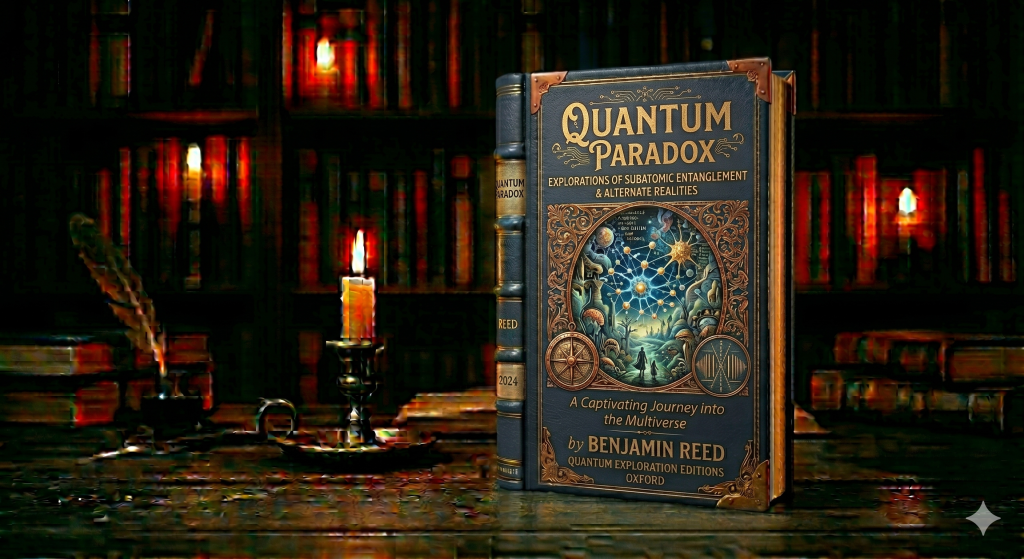
Quantum Paradox – A Journey Through Time, Reality, and the Limits of Understanding
In the ever-expanding landscape of science fiction, few narratives dare to confront the deepest mysteries of existence with both intellectual rigor and emotional depth. Quantum Paradox is one such work—a bold and intricate novel that challenges readers to question the very nature of reality, time, and consciousness. Blending cutting-edge scientific ideas with a gripping human story, it stands as a remarkable exploration of what happens when the laws of physics begin to unravel.
More than a tale of advanced technology, Quantum Paradox is a philosophical odyssey. It delves into the fragile structure of cause and effect, the possibility of multiple realities, and the consequences of tampering with time itself. Through its layered narrative and compelling characters, the novel invites readers to step beyond conventional thinking and into a universe where certainty no longer exists.
Introduction: When Reality Breaks
The story unfolds in a near-future world where breakthroughs in quantum computing have revolutionized science. Humanity has unlocked the ability to simulate complex systems with unprecedented accuracy, leading to discoveries that blur the line between theory and reality.
At the forefront of this revolution is the Quantum Continuum Project, a top-secret initiative aimed at harnessing quantum mechanics to manipulate time. What begins as a scientific endeavor quickly evolves into something far more dangerous.
The concept of a “quantum paradox” lies at the heart of the narrative—a contradiction that arises when actions in one timeline affect outcomes in another. As researchers push the boundaries of possibility, they discover that reality is not as stable as it seems.
Plot Overview: A Fractured Timeline
The protagonist, Dr. Adrian Kessler, is a brilliant physicist known for his groundbreaking work in quantum entanglement. Driven by curiosity and ambition, he becomes the lead scientist on the Quantum Continuum Project.
Kessler and his team develop a device known as the Chrono Engine, capable of sending information—and eventually matter—across time. Initially, the experiments are limited to small-scale tests, such as transmitting data a few seconds into the past.
However, when a critical experiment goes wrong, the consequences are immediate and catastrophic. Time begins to fracture. Events repeat, diverge, and collapse into one another. People experience memories that never happened, while others vanish entirely.
As reality becomes increasingly unstable, Kessler realizes that the team has triggered a cascade of paradoxes. Each attempt to fix the problem only makes it worse, creating a tangled web of alternate timelines.
Amid the chaos, Kessler encounters another version of himself—one who claims to have already witnessed the end of everything. This encounter sets the stage for a race against time, where the stakes are nothing less than the survival of reality itself.
Themes: The Fragility of Existence
1. The Illusion of Time
One of the central themes of Quantum Paradox is the nature of time. The novel challenges the traditional view of time as a linear progression, instead presenting it as a dynamic and malleable construct.
Through the concept of branching timelines, the story suggests that every decision creates a new reality. This raises profound questions: if all possibilities exist simultaneously, what does it mean to choose?
2. Cause and Effect
The breakdown of cause and effect is a key element of the narrative. Actions no longer produce predictable outcomes, and consequences can precede their causes.
This inversion of logic creates a sense of disorientation, both for the characters and the reader. It highlights the delicate balance that governs reality—and how easily it can be disrupted.
3. Identity and Multiplicity
As multiple versions of characters emerge, the novel explores the concept of identity. Are we defined by our choices, our memories, or something deeper?
Kessler’s interactions with alternate versions of himself force him to confront these questions. Each version represents a different path, a different set of decisions, and a different outcome.
4. The Ethics of Knowledge
The pursuit of knowledge is a double-edged sword in Quantum Paradox. While scientific discovery drives progress, it also carries risks.
The novel examines the ethical responsibilities of scientists, questioning whether some boundaries should never be crossed. It serves as a cautionary tale about the dangers of unchecked ambition.
World-Building: A Universe in Flux
The world of Quantum Paradox is both familiar and surreal. At first, it resembles our own—a technologically advanced society on the brink of a new era.
However, as the paradoxes unfold, the environment begins to change. Buildings shift, landscapes alter, and entire cities flicker between different states of existence.
These transformations are described with vivid detail, creating a sense of unease and wonder. The instability of the world mirrors the instability of time itself, reinforcing the central themes of the story.
Character Development: Fragments of the Self
Dr. Adrian Kessler
Kessler is a deeply complex protagonist. His journey is one of both external conflict and internal struggle.
Initially driven by curiosity, he becomes increasingly burdened by guilt as the consequences of his actions unfold. His interactions with alternate versions of himself add layers to his character, revealing different facets of his personality.
Dr. Elena Voss
Elena Voss, Kessler’s colleague and confidant, serves as a moral counterbalance. While equally brilliant, she is more cautious, constantly questioning the implications of their work.
Her relationship with Kessler evolves as the story progresses, shifting from professional collaboration to emotional connection.
The Other Kesslers
The presence of multiple Kesslers is one of the most intriguing aspects of the novel. Each version represents a different outcome, offering insight into the nature of choice and consequence.
These interactions create a rich tapestry of perspectives, adding depth to the narrative.
Conflict: A War Against Time
The central conflict of Quantum Paradox is not against a single antagonist, but against the very fabric of reality.
As paradoxes multiply, the boundaries between timelines begin to collapse. The characters must navigate a world where nothing is certain and everything is at risk.
Efforts to stabilize the timeline lead to increasingly desperate measures, culminating in a high-stakes attempt to reset reality itself.
Scientific Concepts: Bridging Fact and Fiction
One of the strengths of Quantum Paradox is its grounding in real scientific theories. Concepts such as quantum entanglement, superposition, and temporal loops are woven into the narrative in a way that is both accessible and engaging.
While the story takes creative liberties, it remains rooted in plausible science, enhancing its credibility and appeal.
Philosophical Questions: Beyond Science
Beyond its scientific elements, the novel delves into deep philosophical territory. It asks:
- Is reality objective, or is it shaped by perception?
- Do we have free will, or are our actions predetermined?
- Can time truly be controlled, or is it an illusion beyond our grasp?
These questions add a layer of intellectual depth, encouraging readers to reflect on their own understanding of existence.
Climax and Resolution: The Ultimate Choice
The climax of Quantum Paradox is a breathtaking convergence of timelines. As reality teeters on the brink of collapse, Kessler must make a decision that will determine the fate of all existence.
Without revealing specific details, the resolution is both dramatic and thought-provoking. It offers a sense of closure while leaving room for interpretation.
Why Quantum Paradox Stands Out
What sets Quantum Paradox apart is its ability to combine complex scientific ideas with a compelling human story. It is both intellectually stimulating and emotionally resonant.
The novel’s intricate plot, rich character development, and philosophical depth make it a standout work in the science fiction genre.
Conclusion: A Reality Worth Questioning
Quantum Paradox is more than just a science fiction novel—it is an exploration of the fundamental nature of reality. It challenges readers to think beyond conventional boundaries and consider the possibilities that lie beyond our understanding.
Through its engaging narrative and profound themes, the book leaves a lasting impression. It reminds us that while we may strive to understand the universe, some mysteries may always remain beyond our reach.
And perhaps, in that uncertainty, lies the true beauty of existence.
